
Two hundred years ago Goole was a small settlement on the River Ouse - now known as Old Goole. There was no town, no high street, and no docks. Yet in 1826, a single business decision set in motion the creation of one of Britain’s most distinctive communities: a town deliberately built by a transport company to serve trade.
This year marks the Bicentenary of Goole, founded by the Aire and Calder Navigation Company at the height of Britain’s Industrial Revolution.
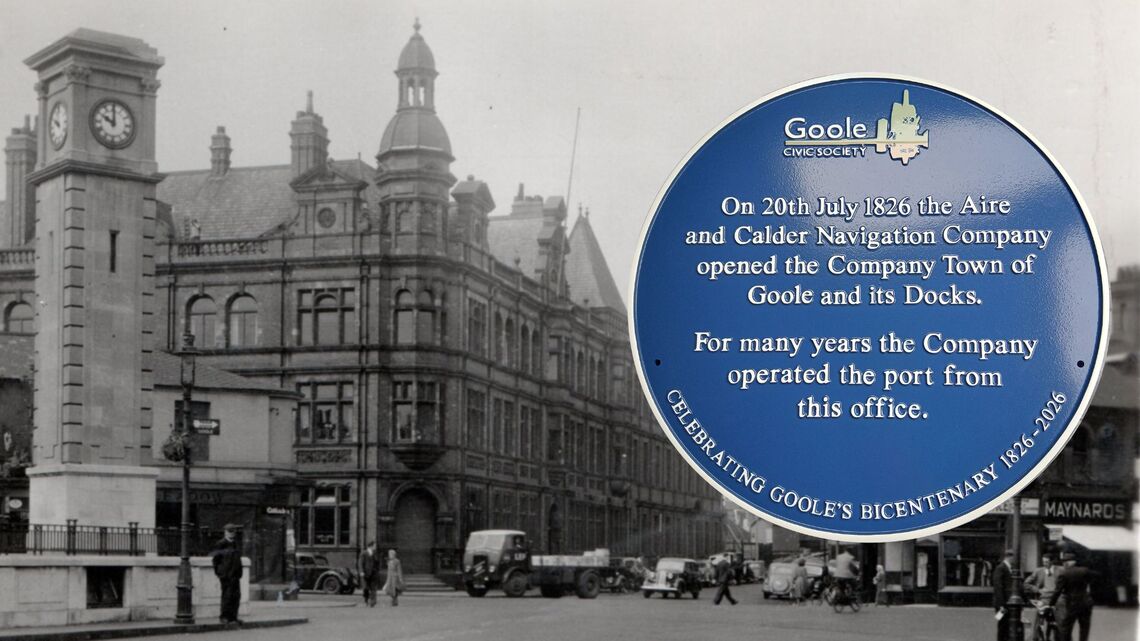
A Town Born from Transport
In the early 19th century, Britain was changing fast. Canals were the lifeblood of industry, moving coal, iron, wool, and manufactured goods from inland towns to the coast. The Aire and Calder Navigation Company already controlled a vast canal network linking Yorkshire’s industrial centres, but it faced a problem: reliance on the busy and expensive port of Hull.
The solution was radical for its time. Instead of adapting an existing settlement, the company chose to build its own port — and its own town.
Goole’s docks were designed to connect canals directly to the River Ouse, giving inland manufacturers access to the North Sea and global markets. Unlike older towns that grew gradually over centuries, Goole was planned from the outset, with docks, warehouses, housing, and streets laid out to serve industry.
Life in the Early Years
When construction began in 1826, Britain was ruled by King George IV, and political power rested firmly with wealthy landowners and industrialists. For workers, life was harsh. Dock labour was physically demanding, hours were long, and safety regulations were virtually non-existent.
Yet the docks also brought opportunity. Jobs attracted workers from surrounding rural areas, and Goole quickly developed into a bustling settlement. While wealthy investors profited most from the new port, the town offered employment and stability in an era of widespread poverty and insecurity.
Canals, Then Railways
At its birth, Goole was a product of the canal age. Barges carrying coal and goods flowed straight into the docks, making the town one of the most efficient inland ports in the country.
Within decades, however, the world changed again. Railways expanded rapidly across Britain, and Goole adapted, linking docks, canals, and rail in a way few towns could. That flexibility — built into the town from the start — helped secure its long-term survival.
A Lasting Legacy
Two centuries on, Goole remains unusual: a town that exists because of transport, shaped by engineering and trade rather than medieval markets or aristocratic estates. Its grid layout, dockside character, and industrial heritage all trace back to decisions made in 1826 by a navigation company focused on efficiency and profit.
As Goole marks its 200th birthday in 2026, historians see it as a powerful reminder of how the Industrial Revolution did not just transform industries — it created entire communities from scratch.
What began as a business strategy on a quiet stretch of river became a town with a lasting place in Britain’s economic and social history.
Interesting facts about Goole
- Goole, East Yorkshire is the UK’s furthest inland port, located on the River Ouse, almost 50 miles from the North Sea. It has been called “a port in green fields” because of its location.
- Our name in unique, though if you try to find it on a popular search engine you will be asked “Did you mean: google”. Goole comes from Middle English, deriving from the word goule, meaning gully or outlet to a river.
- The first settlement, now known as Old Goole, was established after Dutch Civil engineer Cornelius Vermuyden diverted the River Don towards the River Ouse in the 1620s on the orders of King Charles I. The diverted river is known as the Dutch River and is crossed by a bridge marking the entrance to Old Goole.
- The much larger port town of Goole was purpose-built as a “company town” by the Aire and Calder Navigation Company, who built a canal from Leeds to Goole and docks leading into the River Ouse. Goole and its docks were established in 1826 and grew rapidly throughout the 19th century.
- The town’s clock tower was built to commemorate its centenary in 1926.
- Goole has a rich maritime heritage and in its heyday boasted a number of shipping companies trading with Europe and the world, rivalling Hull. There were even passenger ferries to Europe. It is still a busy working port, handling around two million tonnes a year. Cargoes include timber, steel, construction materials, biomass and wind turbines.
- For more than 150 years the port was a hub for the export of coal arriving from the Yorkshire coalfields via the canal and railway until their decline in the 1980s. Engineers developed a system of transporting coal along the canal that was unique to Goole. Compartment boats, nicknamed Tom Puddings, probably because they looked like pudding tins, were linked together in long ‘trains’ and pulled along the canal by a tug. At the docks, hydraulic compartment boat hoists lifted the Tom Puddings and tipped their contents into the holds of waiting ships. Only one of the original five compartment boat hoists survives and is now a Grade 2* listed building. It is one of the town’s landmarks and is depicted on Goole Civic Society’s logo.
- Other landmarks are the town’s twin water towers – nicknamed the Salt and Pepper Pots, the spire of St John’s Church, which towers over the docks, and the dock cranes. This familiar skyline can be seen from whichever way you approach Goole – by road, rail or along the canal or River Ouse.
- In August 1915, Goole was bombed in a zeppelin raid, which killed 17 people. Sixteen of these are buried together in the town’s cemetery and their memorial was restored last year to mark the centenary.
- Goole also had its own shipbuilding and repair company on the Old Goole side of the Dutch River until the 1980s. Sections of the Mulberry Harbour used in the D-Day landings were constructed in Goole and floated to France. Goole Shipyard also built the Blue Bird IV luxury motor yacht for world speed champion Sir Malcolm Campbell in 1938.
- Goole has two marinas, one on either side of the Aire and Calder Navigation, linking boaters to the rest of Britain and beyond via the canal network or River Ouse and Humber.